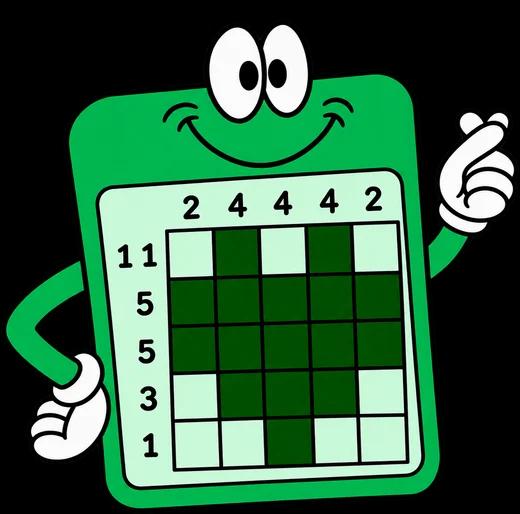
Nonograms were invented in Japan in the late 1980s and picked up a dozen names on their way around the world, from Hanjie and Griddlers to Picross; if you would like the whole story, read our history of nonograms.
Nonogram rules: how Hanjie, Griddlers and Picross puzzles work
A nonogram is a grid of empty squares with numbers beside every row and above every column. Your job is to decide, square by square, which ones to fill in. When you are done, the filled squares form a picture.
- Each number is a block: that many filled squares in a row, with no gap.
- The numbers come in order. Beside a row, they read left to right. Above a column, top to bottom.
- Between two blocks there is at least one empty square. Before the first block and after the last one there can be any number of empty squares, including none.
So a row marked 3 1 holds three filled squares side by side, then at least one gap, then a single filled square. Where exactly they sit is what you work out. A well-made nonogram has exactly one solution, and you can reach it by logic alone, without guessing.
Before you start: pencil, eraser and the little x
On paper, use a soft pencil and keep an eraser nearby. You will make two kinds of marks, and the second one matters just as much as the first:
- Fill a square when you are certain it belongs to the picture.
- Put a small x (or a dot) in a square when you are certain it stays empty.
Never mark a square you are only hoping about. And when a block is finished, cross out its number in the clue. In a big puzzle, those crossed-out numbers are your map of what is still left to do.
Step 1: Full lines and lines that fit exactly one way
Start with the easy wins. A clue that equals the width of the grid fills the whole line. A 0, or a line with no clue at all, is crossed out from end to end.
Next, look for lines where the clue fits exactly. Add up the numbers, then add one for every gap between blocks. If the total equals the length of the line, there is only one way to place them.
Step 2: The overlap trick for big numbers
This is the most useful move in any nonogram, and it is how you start almost every puzzle. Take a big number and imagine its block pushed as far left as it can go, then as far right. The squares the block covers in both positions are filled, wherever the block really sits.
You do not have to draw it every time. There is a quick count: take the length of the line, subtract the numbers and the gaps between them. What is left is the slack, how far the blocks can slide. Any block longer than the slack gets block minus slack certain squares in its middle.
For a single number it is even simpler: twice the number, minus the length of the line. A 7 in a line of 10 gives 2 × 7 − 10 = 4 filled squares. If the result is zero or less, the overlap gives you nothing yet.
The trick works with several numbers too, as long as you compare each block only with itself:
Step 3: Cross out the squares that can't be filled
Empty squares are information. You will find them in three places:
- Finished lines. Once every block of a line is in place, cross out all the other squares.
- Squares out of reach. If no block can stretch far enough to cover a square, it is empty.
- Gaps too small. A space between two crosses (or a cross and the edge) that is shorter than every block that could go there stays empty.
Step 4: Work from the edges
The edge of the grid is a wall, and walls help. If a filled square sits in the very first square of a line, it must be the start of the first block. Fill the whole block from the edge and put an x right after it.
A filled square a little way in works the same way. Ask which block it can belong to, then push that block against the wall and away from it. The squares it covers both times are yours.
Step 5: Split the line and count
Once a line has a few crosses, stop seeing it as one long line. The crosses cut it into short pieces, and each piece is a small puzzle of its own. Ask which numbers fit into which piece.
Counting helps too. Add up a line's numbers and compare them with the filled squares you already have. If the clue says 7 and you have 7, cross out the rest. If the empty squares left are exactly as many as the filled squares still missing, fill them all.
Step 6: Rows, then columns, then rows again
Here is the rhythm of every nonogram. Every square you fill in a row is also a square in a column, so it is a new clue for that column. Go through all the rows, then all the columns, then the rows again. Each pass finds a little more, and the picture slowly comes out of the grid.
Beginners often stare at one stubborn line for too long. If a line gives you nothing, move on. The crossing lines will hand you new squares, and you will come back to it with more to work with.
Stuck? Five things to check
- Look at the edges again. The first and last rows and columns are the most often missed places.
- Ask whose square it is. For every filled square, work out which number it belongs to. Often only one number can reach it, and that tells you a lot.
- Count. Compare the numbers in the clue with the squares already filled and the squares still open.
- Compare the two options. When a line can only go two ways, the squares that are the same in both are certain.
- Take a break. A fresh look after a cup of tea finds things a tired one doesn't.
What not to do: guess. A good nonogram never needs it, and a guess you can't undo will spoil the rest of the grid. If a puzzle truly can't be solved without guessing, the fault is in the puzzle, not in you.
Solve a 5×5 nonogram with us, step by step
Time to put it all together on the little heart from the top of this page. Here it is blank. Green marks show what each step adds.
1. Full lines. Rows two and three say 5 in a grid five wide. Fill them both.
2. Overlap. Row four says 3. Twice three minus five is one: the middle square is filled.
3. Finished columns. The first and last columns say 2, and they already have two filled squares side by side. They are done, so cross out the rest of them.
4. Back to the rows. Row four now has only three open squares for its 3, so fill them. The top row has three open squares for 1 1: one, a gap, one. It fits only one way.
5. Columns again. Columns two and four already have their 4, so their bottom squares are crossed. The middle column has an x on top, so its 4 must run down to the bottom.
Every move here is one you met above: full lines, overlap, crossing out finished lines, fitting a clue into the space that is left. Big puzzles take longer, but they are built from exactly the same moves.
Where to find good printable nonograms
The best way to get better is to solve, and the best puzzles to learn on are small, clean and tested. Watch out for puzzles made in bulk by a computer: some have more than one solution or need a guess somewhere, which is frustrating when you are still learning the moves.
That is why we make ours by hand. We have drawn nonograms for Slovak and Czech puzzle magazines for sixteen years, and every one is solved and tested before it goes out. With Grid Minded you get five printable nonograms every Tuesday as a PDF, with the solutions in your library online. Print them, pour a coffee, and use what you learned here. The first 14 days are free.